Entrance to the Barn Dojo....
Showing posts with label Goju kata. Show all posts

Thursday, June 07, 2018

The hemlock trees are dying

It was wet in the woods the other day. Actually, I think this was two or three weeks ago now--it's been quite busy lately and I lose track of the time. Spring had arrived and everything was alive. Even the spiders were out. I could hear the stream that runs down the hill to the reservoir. In places where the evergreens were thickest, the forest didn't look all that different in the spring as it did in the midst of winter. But the maples and the oaks and the birches and hickories were starting to leaf out and it was easier to see which trees had died over the winter, opening up patches in the canopy. On the ground beneath them, you could see seedlings ready to take over. On the part of the trail where it's widest and there seems to be the most sunlight, small hemlock saplings, no more than a foot or two high, had sprung up along each side of the path. Further up the trail, the giant hemlocks stood, many of them over a hundred feet tall by the look of them, and stately--they seemed to have no need for spreading branches to establish their places like the spruce trees or the balsam pines.

In the first technique of Seiunchin,
both arms are initially brought up
to the outside of the attacker's arm.
But the older hemlock trees are dying. I could count dozens of them along the trail and more off in the woods, the bark stripped off in places, left like red mulch around the base of the tree. They've been hit by the wooly adelgid. It's an invasive species for which the hemlock has no natural resistance. The wooly adelgid brings the borer beetle, which feeds on it, and then, after the borer beetles have burrowed beneath the bark of the tree, the woodpeckers attack, stripping the bark to get at the beetles. Fungus begins to grow around the roots of the diseased tree, and before long, the tree falls. The cold New England temperatures kept the pest at bay for years, but now they're heading north as the winters warm, and the hemlock may go the way of the American chestnut. It shows, I think, it's all tied together; a chain of events that seems to connect things in a way that's difficult to see at the start--one thing leading to another or, if not so singularly predictable, a step in one direction changing the expected outcome while opening up any number of different possibilities, like a small alteration in the environment opening an existential niche that may not have been there before. 

The initial counter from the first
sequence of Kururunfa.
For some reason, all of this made me think of how we string the various techniques of a kata together. But I wasn’t thinking about the sequences of techniques in the standard way in which it is shown in kata—beginning with the receiving (uke) technique, then progressing with the controlling or bridging technique, and finishing with a throw or an attack to the neck or head--as much as I was thinking about how an understanding of the structure and themes of a kata allows one to move between the techniques of different kata within the system. Because the Goju-ryu classical kata are composed of sequences—with entry techniques and bridging techniques and finishing techniques—it’s fairly easy to begin with a technique from one kata and then, depending on how the attacker is moving or responding to your initial receiving technique, move into a bridging technique from another kata and, again, tack on a finishing technique from yet another kata. Understanding the themes or principles of the various classical subjects also helps facilitate this sort of flexibility, especially when each kata seems to be exploring a different theme or response to a different sort of attack--that is, the receiving techniques seem to show the most variation. How one bridges the distance in order to control the opponent may also show a certain amount of variation but the idea here is basically to maintain contact after the initial receiving technique and, without putting oneself in further danger, moving to the opponent’s head or neck to finish the encounter. 
Continuing with the first technique
from Seipai (on the non-kata side).

For example, in the opening move of Seiunchin kata—and in fact in many of the other techniques of this kata—both arms are brought to the outside of the opponent’s attacking arm, whether we see this attack as a wrist grab or a punch or a grab of one’s clothing. If one were to continue the sequence, the defender’s left hand would rotate in order to grab the attacker’s left wrist as the right forearm was brought down on the attacker’s elbow. This is the position in kata that looks like two down blocks in shiko dachi (horse stance) done at a 45 degree angle.

However, if one is thinking about variations, it is easy to see how the defender might move from this initial position in Seiunchin kata to the first attack in Kururunfa kata. The defender need only maintain contact with his right arm on the attacker’s left arm, releasing the left grab, and bring the left forearm up into the neck of the attacker. This is then followed by a left knee kick. 
Continuing with this technique from
Seisan kata by dropping the left arm
and stepping in behind the opponent.

But if these counter attacks are somehow thwarted, the defender can then tack on the first technique in Seipai kata (though it would be from the non-kata side), with the left forearm brought up alongside the neck, since the initial straight arm technique begins from this position with the elbow or forearm attacking the opponent’s face or neck. 

Or, by dropping the left forearm down along the back of the opponent’s left arm and moving to the back, the defender could continue with the bridging and finishing techniques from the first sequence of Seisan kata. 


Continuing with the pull down
technique from Saifa kata.

[Me with Bill Diggle from photos
we did for the book, The Kata and
Bunkai of Goju-Ryu
.]


Or, once to the back of the opponent, the defender could grab both shoulders, as we see in Saifa kata, and pull the attacker down onto the knee and attack with the hammer fist strike. 

I think it is important to see the connections, but we can only really be comfortable with these kinds of connections when we understand the sequences of a kata and see the themes or principles contained within them. Once we are able to do that, the attack becomes relentless, sort of like the attack of the wooly adelgid on these stately Hemlock trees, I think. 

Hemlock tree after it has
been attacked by the
wooly adelgid, borer
beetles, and woodpeckers.


Friday, March 16, 2018

The influence of the times

The vernal pools have started to appear along the trail. It's early spring. There are Canada geese overhead. A light coating of snow from the day before has melted and turned the trail to mud wherever rivulets of water run down the slightest incline or an old stream bed crosses the trail. In the summer these running springs dry up, leaving only rounded rocks and boulders in their place as if a glacier receded, leaving behind these miniature finger-like moraines. Actually, this whole mountain, quite surprisingly, was once volcanic. Blackened bits of volcanic rock appear haphazardly along the edge of the woods in the summer when the trail is dry and the leaves have been shredded and stamped to a fine dust by hundreds of hiker's boots and dog paws, eroding the trail another sixteenth of an inch, compacting the ground over time, ensuring that there is a trail immune from the efforts of long-buried acorns and catkins and trailing vines trying to push their way up through the soil.
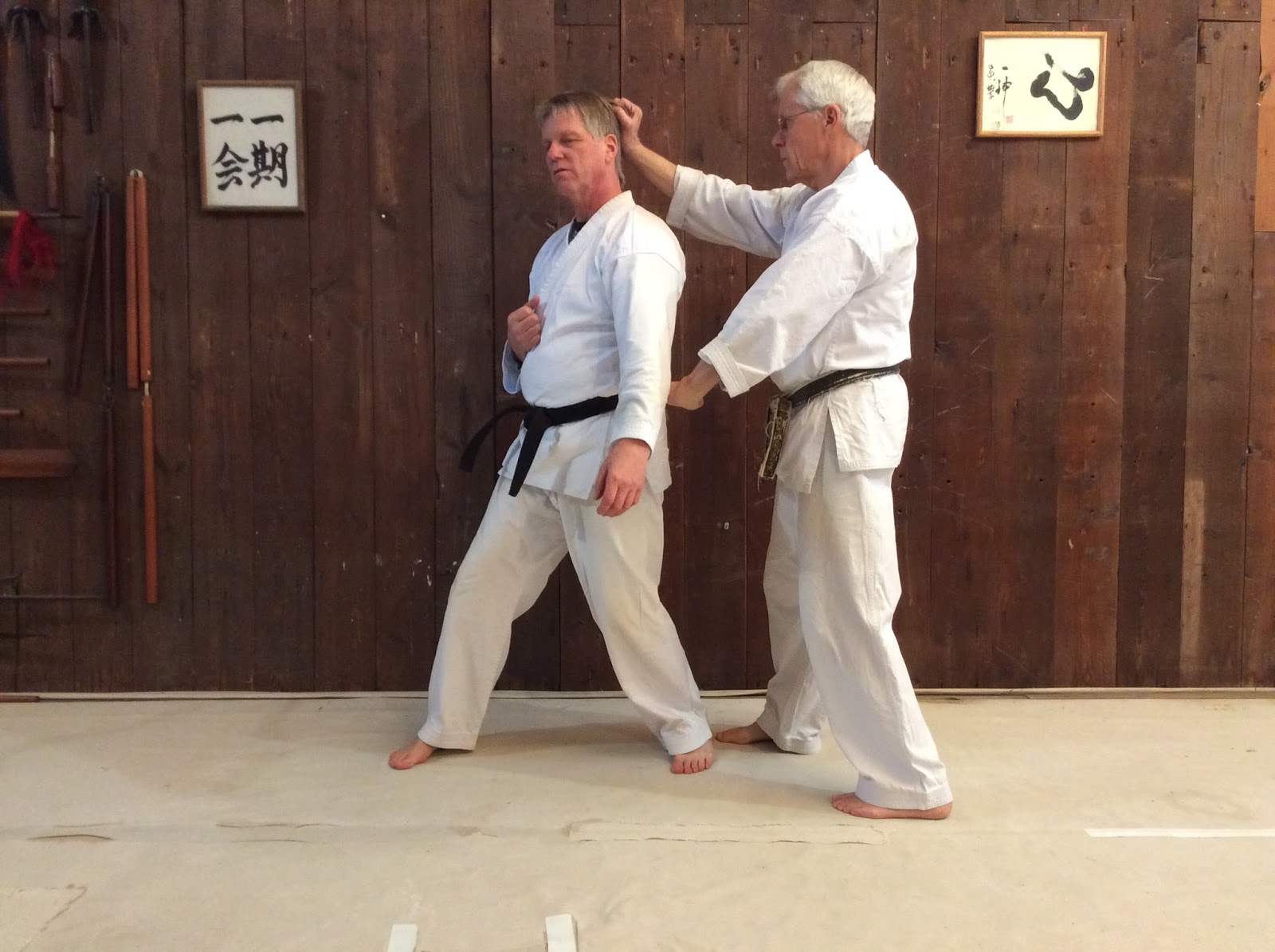
One of the hair-grabbing techniques
from Seipai kata.

Today, however, there are long wet smudges where a boot heel has so obviously slipped or skidded across the watery surface of a flat rock. These skid marks tend to color my perception of the trail, and I find myself carefully watching where I put my feet, though in reality there are thousands of footprints going up this trail and very few places to mark where someone has slipped or lost their footing.

In the wet places, where these vernal pools appear, there are "social paths" that now meander off through drying woods and ground that seems a bit higher than the trail. A small cluster of beech trees stands at a bend in the trail, each with someone's initials carved in its smooth-barked trunk. It reminds me that this forest which was once a primal wilderness has now been largely tamed. The trails have been cut and the woods is managed to some extent. There are regular forays of bird watchers and dog walkers and concerned citizens looking for non-native invasive species to rip out and cart away. My perception of the forest, and what I should like to call "the wilderness," has been conditioned, no doubt influenced by the times.

One of the hair-grabbing techniques
from Saifa kata. The left hand has
grabbed the hair or topknot.
In some sense, this is like looking at kata through a glass darkly, like looking through an early morning fog that sits in the valley, hiding the river and the woods on the opposite bank, trying to discern not only the movements of someone in a distant clearing doing kata but the reasons for the movements as well, the
bunkai. We are conditioned, it seems to me, to see fighting or self defense in terms of blocking, punching, and kicking. We tend to interpret our martial arts in familiar terms, as something akin to boxing. Everyone is familiar with fisticuffs, dust-ups, brawls--all substitutes for boxing matches of one kind or another. But what if, looking back some two hundred years or so, the times themselves influenced the martial arts of the period? And the irony is that we are left with the outward form (kata) of this ancient martial tradition, yet we attempt to interpret how to use it (bunkai) by overlaying it with a 21st century template. It's as if we set out to trace letters on a stencil where we had accidentally superimposed a sheet of arial fonts over an ornate gothic alphabet.

Of course, much of this line of speculation only raises more questions. There are few easy answers here. Many of the self defense techniques of Goju-ryu classical, or as some say koryu kata, seem to begin from a grappling posture with a variety of techniques against grabs of one kind or another. Was this a response to how people dressed in ancient times? Was punching from the distance of an arm's length less likely and more awkward if one wore loose robes? Was one less likely to kick with the foot if one wore sandals or geta or zori? So many of the controlling and finishing techniques we find in Goju-ryu classical kata seem to show the grabbing of the opponent's hair or topknot or queue, and knee kicks (hiza geri) seem much more prevalent. Do we no longer "see" these techniques in kata because most people nowadays wear their hair short? Does the fact that we wear shoes most of the time make kicking with the foot a better option?

If the martial arts were largely practiced by--perhaps even developed by--the military classes, wouldn't you be most likely to fight empty handed only after you lost your weapon? And in that case, wouldn't you be most likely to charge your opponent, who may still have a weapon, so that his use of that weapon would not be to his advantage? In other words, would I really want to stay at a boxing range, arm's length, against someone with a weapon? Granted, the safest thing to do would be to run away. But if one chose to fight, and one could close the distance safely, wouldn't the ensuing brawl involve grappling?

I think in some sense this may involve the practice of weapons (kobudo) too, and particularly the staff or rokushakubo. Again, this is pure speculation on my part, but if--merely a fanciful hypothesis--practice of weapons was also mainly engaged in by the military classes, wouldn't these long weapons have been pointed or bladed for the most part? And if that's the case, as a more likely scenario, does that change how we "see" certain "poking" or "hooking" or "pulling" movements in different bo kata? That is, if the rokushakubo kata--e.g. Shushi no kon, Tsuken no kon, etc.--were actually first developed to preserve techniques of a halberd-like weapon, how would this change the way we viewed kata, and especially bunkai? This style of bo and these kata were clearly developed to utilize both ends of the staff--either blocking with the front end and quickly attacking with the other end or blocking/parrying with the heel end and quickly attacking with the front end. (This double-ended bo technique, I was once told by a noted Chinese sifu after I had demonstrated Tsuken no kon, was called dragon staff.)

A collection of Chinese bladed
weapons in the Matayoshi
hombu dojo.
But in some kata, the slicing (if that's what it is) or hooking or pulling motions seem to all be executed with one end of the staff. If only one end of the weapon had a hook (like the
nunti bo, for instance) or a blade of some sort (like all of the Chinese long weapons that stand in a rack at the front of the Matayoshi hombu dojo), could this explain the apparent different uses we see of the two ends of the staff? And did the substitution (if that's indeed what happened) of a staff for a more militaristic bladed or halberd-style weapon come about due, once again, to the influence of the times?

I can walk off in the woods and pretend that I've left civilization for a time. I can sit on a log under a leafy maple tree, and if I'm quiet enough and up-wind, a deer might wander by or an owl might perch in the same tree. But as I walk up the mountain, I see a tree that fell across the trail last week carefully cut in thirds, its pieces rolled to the side to clear the way for us wilderness hikers.

[For a more detailed discussion of these techniques see my book, The Kata and Bunkai of Goju-Ryu, here.]

Sunday, September 03, 2017

Footfalls in the woods and Suparinpei

I was off in the woods a few weeks ago, swatting at black flies and being careful to avoid the poison ivy and the long blades of grass that reached out over the trail, affording ticks an ideal jumping off place from which to latch onto unwary travelers. It was hot--95 degrees F. (35 degrees C.), but the heat index had it at 103 degrees F. Even the birds seemed to be silenced by the heat. Most of the time, all I could hear was the quiet plodding of my own feet as I walked along a trail covered in the remains of last fall's leaves. This was certainly not the "road less travelled." I was following in the footsteps of countless numbers of other hikers who had passed this way. Sometimes I could see the evidence: an upturned rock or the imprint of a boot heel that had sunk unexpectedly in the mud. The trail was wide enough that I could probably have followed it at night, which made me think of that quote by Miyagi Chojun sensei. Not that Miyagi sensei had said it in any of his own writings, but it appears in Memories of My Sensei, Chojun Miyagi, where Miyagi supposedly tells Nakaima that “Studying karate nowadays is like walking in the dark without a lantern.” Of course, nowadays we have battery-powered headlamps, though I doubt if it makes much difference in our understanding of karate.

And yet the trail is wide enough. We would be hard pressed to lose sight of the path--so many karate-ka have walked this way before. What gives me pause, however, are the contradictions in the metaphor: generations of karate-ka practicing diligently, trudging along this well-worn path in the dark.

I was watching a video the other day. It was originally posted a year ago, but, after taking a seminar, someone had reposted it on Facebook. It had to do with the bunkai to the last technique in Suparinpei, the last kata of Goju-ryu and, at least in some symbolic way, the ultimate technique of the system. And, to many, I suppose, it must seem so esoterically enigmatic. 

This was a short video but it was by a very well-known karate researcher--a teacher who has written many books on the history of Okinawan karate, and so must have carried with it some weight of legitimacy, some knowledge of "Okinawan karate secrets."

The starting position had the teacher with his back to the attacker, who had grabbed him by the shoulders with both hands. From there, he showed the response of the defender, which began with a slight shifting rotation of the body to the right which, the teacher said, would provoke a stiff right arm response from the attacker. At this point, he lunges forward and, looking back at the attacker, does "the distraction," a slapping technique with the back of the left hand aimed at the attacker's groin. At the same time, he head butts the attacker and then slides his head between the attacker's arms--who, in the meantime, has not altered his position or grip on the defender's shoulders--and, with his head now coming up on the outside of the attacker's arms, he brings his left forearm down "hard" on the "brachioradialis" before the opponent even "thinks about a choke." Next he attacks with a right nukite into the opponent's throat. At the same time, he wraps his left arm around the attacker's right arm at the elbow, as his right arm grabs hold of the attacker's lapel. Then, dropping down into horse stance, he tightens the restrictions on the opponent's right arm/shoulder and, with the right wrist, the attacker's neck, until the attacker submits.
Entry technique.

So what's wrong with that? It works in the dojo. And it's wonderfully imaginative. But does it look like kata? I mean, doesn't kata face south and then turn to the north? Does it take too long? It certainly takes too long to describe. Is it realistic? That is, why would you ever think of sliding your head between the attacker's arms? Does this sort of bobbing movement occur in the performance of the kata? Why doesn't the attacker move or alter his position? Does it require the attacker, an unpredictable component of the equation, to conform too readily to the defender's expectations; that is, does the attacker have to behave too predictably? Does it fail to take into account the entry and controlling techniques that precede these movements in kata? Or is this just one possible explanation for these techniques in Suparinpei? And if it's just one of many possible explanations for these techniques, is that simply a confirmation that we are indeed still stumbling along the road "in the dark without a lantern?" 

Controlling technique.
Or is it more likely that this ending sequence to Suparinpei borrows both from Seisan and Sanseiru, and that the explanation of the techniques, the analysis or bunkai, simply shows a variation of how the same techniques are applied in each of those other kata? The entry techniques are shown over and over again in the three complete bunkai sequences of Seisan kata: a sweeping, semi-circular right arm block, while stepping 90 degrees off-line into a left-foot-forward front stance, followed by a left straight-arm palm strike to the side of the face. We see the same entry technique here in Suparinpei. The straight-arm "nukite" in Suparinpei is akin to the straight punch at the end of Seisan kata. Then the turn into what is called here the "dog posture," the last posture of Suparinpei, in horse stance with arms bent and both wrists up and fingers pointing down, shows a variation of the same position at the end of Sanseiru, though the stepping is a little different.
Finishing technique.

In one sense at least, I wonder about the realism of techniques that look as if they would only work in the dojo with a compliant partner, the fanciful creations of individuals whose interpretations don't seem to be grounded in sound martial principles. Such inventions--because we are all supposedly "walking in the dark without a lantern"--confuse legitimacy with creativity; we look at these interpretations with a mixture of confusion and awe, and think, "Gee, I never thought of that." But are all creative interpretations equally valid? Is that the point of kata, to foster creativity? I am certainly not trying to denigrate any of these instructors, nor disparage their interpretations, if that's what kata is. But it seems to me that even if we consider it "art," we don't have license to interpret it any way we want. The idea, it seems to me, is not to impose meaning on what seems to be random and arbitrary, but to discover what the artist--in this case the creator of a kata--is trying to communicate.

Even theory in science, for example, is not simply invention; it's based on an understanding of the underlying principles. Have we forgotten what we learned of the scientific method in middle school? We seem to be living in an age where science has been shouldered aside, where skepticism seems to be leveled at scientific inquiry and tabloid journalism has become the norm. Perhaps that's part of the problem. Who are we following on this proverbial path through the woods? Or is everyone simply striking out on their own? Seems as though there should be some sign posts along the way--the martial principles that all too often seem to be ignored. Is this why we are all still stumbling along without lanterns to light the way?


Tuesday, August 15, 2017

Does nobody ask why?

It was early Spring and the woods were wet. It had rained pretty steadily for two days. And before that it had been cloudy and drizzling more often than not. The path along the swamp was flooded over and every dip in the trail was damp from slowly drying puddles of standing water. But plants were starting to sprout. In places, ferns and broad-leaf marsh plants hid the rocks and threatened to obscure the trail. Small, delicate looking wild flowers sprang up in places where the sun managed to get through the canopy of new leaves overhead. It reminded me of that part in Robert Fulghum's book, All I Really Need to Know I Learned in Kindergarten, where he says: "Remember the little seed in the Styrofoam cup. The roots go down and the plant goes up, and nobody really knows how or why...."

But then I thought, really? Really nobody knows how or why plants send their roots down into the

soil and the plant slowly pushes up through the forest floor? Really? Maybe Fulghum was not looking for a scientific explanation. Maybe it was a sort of rhetorical question--even though it seemed to be a statement--some sort of ontological inquiry and the little plants were only meant to be stand-ins. Inquiring minds want to know.
The slow "punch" from the beginning
of Sanseiru kata.

I thought of this because I was watching a video the other day on the Goju Ryu kata Sanseiru and its bunkai, or at least what was purported to be bunkai. I always thought that bunkai was "the analysis of kata" and therefore had to follow the movements and techniques of the kata. So you can't change the kata movements, it seems to me, when you're trying to explain how they are used. And yet, here was a well-respected teacher of Okinawa Goju-ryu demonstrating his "bunkai" or explanation of the three slow punches at the beginning of the kata, only in his application the punches were not slow at all but fast chudan punches to the opponent's ribs. And the open hand technique that follows the third punch was used to check the opponent's chambered punch--blocking the opponent's chambered fist with the extended palm before he even thinks of punching! And this was followed by a fast punch (though in kata there is no punch of any kind after this open hand!).

Does no one ever ask why the punches at the beginning of Sanseiru are done slowly and the punches at the beginning of Seisan are fast? If the techniques are done differently in kata--slow in Sanseiru and fast in Seisan--shouldn't the explanation of their application be different as well? Is it possible that the "punches" in Sanseiru are not meant to be punches at all? (And while we're at it, what about the double-arm posture? Is this a hold over from the days of the Marquis de Queensbury or is there a message here?) Sometimes I feel like I'm in Bizarro World waiting for Superman to come straighten everything out.

The first technique in Seiunchin kata.
Years ago now, I came across an explanation (read "bunkai") of the first technique in Seiunchin where the defender was stepping back, using both hands to release the attacker's choke hold. The teacher explained that the kata steps forward on a more-or-less 45-degree angle but in application one is meant to step back. I found this particularly confusing. Does that mean that the kata is showing everything in reverse, opposite to what the defender is supposed to do in application?! Rather than searching for some ridiculous rationalization for an interpretation, shouldn't we be questioning the interpretation? Instead of trying to justify things that don't make a whole lot of sense in the first place, shouldn't we simply follow the kata and, in the case of Seiunchin for example, ask what could be happening if the kata is telling us to step forward along a 45-degree angle? (Obviously not a release from a chokehold!)


There is a lot of mystery in the world. There are also things that we just plain don't know yet. But there's also a lot that we can figure out. A good deal of it is just plain logical. After all, the roots go down and the plant grows up...and the wheels on the bus go round and round. Just follow the kata.

Thursday, April 27, 2017

"Don't hit anyone..."

Sometimes I head off into the woods just to escape. Even here, a little more than a mile from downtown, I can get far enough up the trails that I can't hear the highway. Once and awhile an airplane will fly overhead, but even then, after my initial irritation has passed, I can imagine some sort of primitive connection to the aboriginal people in that old movie, "The Gods Must Be Crazy." Above the canopy of trees, it's hard to see the airplane. Perhaps it's just the flatulence of the gods.

The trees, of course, are peaceful beings. If you walk in the woods often enough, especially in the spring, you can see them come alive again after a long winter. There aren't too many examples of living things that simply exist in harmony with their environment, living peacefully. Trees seem to. Oh, I know trees aren't sentient beings. Of course not. Certainly there's a lot we don't know about our world--it would be arrogant to
Miyagi Chojun sensei.
think otherwise--but I'm pretty sure trees aren't conscious or self-aware, though I'll keep an open mind on the subject. But at least in some imaginative or metaphorical way they present us with a wonderful example of peaceful co-existence, like that tree in the Shel Silverstein book.

I was thinking about all of this because we seem to be living in strange times...though that's only a euphemism for all the anger and nastiness and distrust and aggressively antagonistic posturing. I'm reminded of the words of Miyagi Chojun sensei that often accompany a frequently reproduced portrait of him: "Do not strike others; do not be struck by others." Wonderful sentiment. I think the trees would approve. But this from a Goju master? Is there something just a bit ironic in this statement? What was he thinking?

Receiving technique from Sanseiru.
I wonder sometimes if he was at all bothered by the violent nature of the martial arts and particularly
some of the violent head-twisting techniques found in the classical kata of Goju-ryu. I wonder myself sometimes if there is any way to minimize the violence inherent in the kata. There have been times when I have explained the bunkai of a kata to people and they will say, "We can't do that. I can't break someone's neck if I get into a fight." But it may say more about how we look to interact with other people, I think. We live in an angry age, where everyone seems ready to pick a fight. Is it at all ironic that if we lived in a kinder and gentler age, our self-defense would only be used in life-threatening situations? Or in ancient times when a confrontation really was life-threatening?
Controlling technique from Sanseiru.

But I still think if we adhere to Miyagi sensei's advice, then what we should spend the most time studying and training in the classical subjects are the receiving techniques and the controlling or bridging techniques. If we can really learn the receiving techniques shown in the kata--how to avoid and "block" the incoming attack--and bridge the distance to control the attacker, then we won't get hit and we won't necessarily need to hit anyone. After all, the finishes are easy; the hard part is how to receive (uke) the attack safely and control the situation so that it doesn't go any further. Whether I use a head-twisting technique to break someone's neck or merely throw someone to the ground is really a matter of how much force or intention is put into the technique.

Of course, in this day and age, it's very unlikely that I would be faced with any situation where I would have to make that choice. Well...unless someone were to jump out from behind that big old hemlock tree and threaten me.


Tuesday, September 13, 2016

Seeing what we expect to see

I am sometimes chided for the bunkai I "find" in kata, as if kata is a piece of clay and I'm molding something out of this amorphous lump of mud. It reminds me of the old Zen parable about a very knowledgeable teacher who one day comes to visit a Zen master. Ostensibly, he comes for instruction, but right away the Zen master can see that the teacher has come to show off his own knowledge or to test the master or some such nonsense. Whatever the case, the master immediately realizes that the teacher has come with a closed mind—that is, he has come with his own set of fully-formed expectations. Nevertheless, the master invites him in for tea. After they are seated, the master begins to pour his guest some tea, but he doesn’t stop when the cup is filled, and the cup overflows, startling the teacher.

Of course at this point everyone—even those who may never have heard the story—can tell that the master will cleverly inform the guest that metaphorically he is like the teacup; he has come already full. And in the mythic world of enigmatic Zen masters, everyone will realize the truth at that moment and experience instant enlightenment…or else the disgruntled teacher will stalk angrily away in search of someone who knows what he knows and is willing to acknowledge him for it. Cynical but perhaps more realistic.

Now I know very few Zen masters, of course, but this same scenario, though slightly varied, happens with experienced martial artists too. Their expectations, however, produce a kind of tunnel vision so that they see only what they have been conditioned to see. Like the old adage about the carpenter who sees the solution to every problem in terms of a hammer and a nail, the karate practitioner who has spent endless hours pounding a punching post (makiwara) tends to interpret all kata in terms of punching, blocking, and kicking. How do we bring an open mind, a beginner’s mind, to the analysis of kata (bunkai)? How do we make sure that we are not bringing a cup that is already full to the table? 


The story is appropriate, as every martial arts teacher is certainly familiar with students who begin with their cups already full. Once and awhile they arrive at the dojo to “test” the teacher, but more often they come in sincerely, even with humility, yet with expectations. Their expectations are filled with preconceptions about karate or just martial arts in general. Sometimes they are able to revise their expectations, but more often than not they just quit and move on, looking somewhere else for something to match their expectations. 

Exercises with the Kongoken.
After all, in Goju at least, there is more hitting with the forearm than with the fist, more kicking with the knee than with the foot, and we generally "receive" the attack rather than block it. Sowhat's with all of the block, punch,  and kick bunkai? When Miyagi sensei saw wrestlers training with the kongoken (large metal oval) on a trip to Hawaii in the 1930s, and then, being impressed with the possibilities and usefulness in hojo undo exercises for Goju-ryu, brought it back with him to Okinawa upon his return, he probably wasn't thinking in terms of blocking, punching, and kicking techniques. But think of grappling and head twisting and it's another story!


Tuesday, October 27, 2015

The Structure of Kata: putting two and two together...or not

Final technique of the opening
sequence of Seiunchin kata.
I was thinking about structure the other day--how we put things together. I suppose in some sense structure is how we make sense of our lives, how we connect things. Writers think about structure a lot, I imagine. You have to when you tell a story. You can begin at the beginning, slowly and painstakingly making your way to the end in the order that things occur, or you can meander this way and that way, filling in details, providing explanations, making sure there are no loose ends, but by all appearances a seemingly chaotic or at least random order. Very few stories, in fact, seem to stick to a linear model. Writers are always experimenting with narrative structure. They have to, I suppose,because they already know the end of the story.

There's a sort of narrative structure to Goju-ryu kata as well. The problem is that the structures differ; not all of the katas conform to the same structure, which, of course, is a strong argument to bolster any research that would suggest that the classical subjects of Goju-ryu, though part of a system, were created by different people at different times. If Goju classical kata were created by a single individual at one period in history--as the Pinan kata are said to have been the creation of Itosu--then they would probably conform to similar patterns, like the Pinan katas. But they don't.
Thematic double open
hand technique from
Shisochin kata.

That being said, there seem to be certain rules that each of the Goju kata do conform to. For example, techniques which are shown twice in a kata are shown on both the left and right sides, but the finishing technique of the sequence is only shown once, at the end of the second repetition. Techniques that are shown three times are usually base techniques (as we see at the beginning of Sanseiru) or thematic (as they seem to be in Shisochin) or indicative of the number of bunkai sequences seen in the kata (as in the case of Seisan and Sanseiru). And techniques that are shown four times (as in the elbow/forearm techniques of Seiunchin) should be treated as two pairs of techniques (though Suparinpei seems to be a whole other kettle of fish).

The other element of structure that seems to be followed in all of the Goju classical subjects is that the turns and changes of direction in kata are not arbitrary but instead indicate the direction of attack and how one should step off the line of attack. And certainly there are others.

Yet even when these "rules" are applied, we still see differences in kata structure within the Goju system as a whole. Saifa and Seiunchin begin with actual bunkai sequences--though two of the opening sequences of Seiunchin are incomplete, the finishing technique being shown only after the third sequence, which in itself is a structural difference from Saifa. Shisochin and Sanseiru begin with basic techniques (three open hand techniques in one and three closed hand techniques in the other), not bunkai sequences per se, that share a thematic connection with the rest of their respective katas. Seisan begins with three sets of three basic openings, while Kururunfa sticks its three basic techniques after the openings that are shown on both the right and left sides. And Seipai begins with a complete bunkai sequence, sort of like Saifa, but only shown once.

Furthermore, Saifa has only four complete bunkai sequences, while Seiunchin has five. Shisochin has
Controlling or bridging
technique from
Sanseiru kata.
three--though there is some variation and repetition even then--just as Sanseiru and Seisan, whereas Seipai has five and Kururunfa, four.

The problem is that you need to understand the structure of a kata in order to understand its bunkai and not fall into the kind of piecemeal analysis that so often characterizes what we see on the Internet and frequently leads to questionable interpretations of kata technique. For example, the last technique of Saifa kata--the step, turn, and mawashi--is probably the finishing technique of the previous sequence, which is itself shown on both sides, beginning with the block, sweep, and hammerfist strike, rather than an independent technique or additional bunkai sequence of its own. Why? Because that's the way the "mawashi uke" technique appears to be used in all of the other classical subjects of Goju-ryu. Not proof, of course, that there isn't an exception, but a strong argument perhaps.

But structure can also "hide" bunkai, and often does in Goju kata, particularly when the initial or opening technique (uke) is separated from what should follow it, the controlling/bridging technique and finishing techniques. This is what we see in Sanseiru kata. Or, when the opening techniques themselves get split up--something we see in the four-direction double arm movements of Shisochin
One of the four double
arm opening moves
of Shisochin kata.
kata--effectively "hiding" how the opening techniques and directional changes are employed.

The question, of course, is why the creators of these kata put them together this way. There's no question that it has led to a great deal of confusion. Did they do it to intentionally hide techniques? Or is it just the most efficient and fluid way to execute the techniques? I've tried to reconstruct kata, stringing complete bunkai sequences together, and it often gets awkward or doesn't finish facing the original front direction. Perhaps it was to emphasize that sequences and combinations could be taken apart and put back together in different ways. Or perhaps they were interested in showing an escalating level of violence--that is, the second of a paired sequence shows a much more violent response. For example, in the final sequence of Saifa kata, the first side shows a block, sweep, hammerfist strike, and undercut, but the second side adds a punch, head-twisting neck break (mawashi), and knee kick. So was the intention to hide technique, or was this common structure the most efficacious and time-saving method of preserving technique? These are, of course, questions that are impossible to answer, but the importance of understanding the structure of kata is obvious.

Tuesday, October 13, 2015

It is what it is...

Opening attack from Seiunchin kata.

I was having an imaginary conversation with my daughter the other day. She isn't actually a little kid anymore, but it was the kind of conversation we used to have fifteen or twenty years ago. You know, the kind of conversations you're never really ready for because you never really imagined yourself as a parent. And who can prepare for that anyway? Or maybe you have the same questions 'cause you never got any better answers than "because it just IS!!"

Or maybe they were just dumb questions, like how come people have eyebrows? Or, why don't animals talk? Or, why does it rain? I was actually wondering about all this because I had just watched a video of Hokama Tetsuhiro sensei demonstrating bunkai from Seiunchin kata. It was on a Facebook page titled: Goju Ryu Karate. It's a short video, about 4 minutes long.
Stepping forward and executing an
arm-bar to bring the attacker's
 head down.

Now I have a lot of respect for Hokama sensei. Back in 1987, I think it was, we were visiting and training in Matayoshi sensei's dojo--going to Okinawa for the first time with my teacher, Kimo Wall sensei, for two months--when Matayoshi sensei invited Hokama sensei, who had studied kobudo with him, to come by the dojo and talk to us. He brought copies of his first book, signed them, and gave them to all of us visiting Americans. Of course, this first edition was in Japanese, but the pictures were wonderful. But, back to the present. In this bunkai video I watched, Hokama sensei was showing what looked like very Aikido-esque techniques. I've seen many teachers concentrate on this sort of bunkai--Kuba Yoshio sensei is another one (here's a video showing other Aikido-like bunkai for Seiunchin: http://youtu.be/KyBXOiucFpk). Kuba sensei does this a lot, but it seems to me a bit of a stretch.

Right hand grabs the head (or top-knot)
and the left comes in to attack and
grab the chin.

And so I wondered why people seemed to be attracted to all of these joint manipulations just to throw the opponent. Is that really Okinawan karate? Doesn't the opponent just get back up and attack again? Is it to find less brutish-looking techniques, less violent alternatives? Is it seen as somehow more exotic and esoteric? Perhaps it appears to be more magical--a slight touch here, a little twist and the opponent is down. If you watch the videos carefully (and a bit critically), you see that the demonstrataed two-person techniques (bunkai?) only partially resemble the moves in kata. Why is that? Why not just come out and say, "Here are some cool moves I found while I was watching stuff from another type of martial art. Hey, if you squint your eyes up, they sort of look like Goju."

Conclusion of the opening sequence
of Seiunchin kata--an elbow attack
to the back of the head, neck, or
spine.
The problem for me is that it's not Goju. Why not? Because these teachers have taken individual techniques out of the kata and theorized about their application without seeing them in the larger context of the sequence of moves that forms a single bunkai combination. They have also not stuck to a strict analysis and repetition of the kata technique--in other words, they are not doing the bunkai for this particular kata. So why call it Seiunchin bunkai? I know some people will call this oyo bunkai or something along those lines; that is, when you start with a technique from kata and then you get "creative" or "personal" with it, as one discussion forum put it. Or how about this? And I quote: "Bunkai is the analysis of kata, and oyo is the application." I'm sorry, but when you analyze moves in kata isn't that the same as figuring out how you apply them? Let's face it, oyo is when you haven't got a clue and you're just making it up. Or it's when you find something really cool but it's not really part of your own system, and yet you'd hate to drop it from your repertoire.

Goju is a close-in fighting system with a lot of grabs and such, but Goju quickly bridges the distance and attacks the head or neck. Neck breaks and head twisting are standard fare in Goju. Why? I don't know why; I didn't make this stuff up. But why? Because it just IS!!!!


Monday, June 15, 2015

Resurrecting the past

Hanging out with Kimo sensei.
Finally back at it...well, almost. Busy month. Five weeks out from total hip replacement surgery. Lying around. A lot of reading and rest. Of course they get you up to walk a little the next day--miracle of miracles--but still. I mean, they cut your thigh bone off and pound a titanium spike down it. No more running marathons, I guess. Slow and rather lengthy recovery...what do they say, at least three months, though more like six to feel "normal" again? Try to get in a mile or so walk a day and some exercises, but nothing all that strenuous. Still limping a bit, but at some point I should be almost like new. Can't really complain. What the hell, at least I can walk again.

I'm always amazed to discover how integrated karate movement is whenever I get injured. Now, of course, it's the realization of how the waist/hip area (koshi, if you will) is involved in everything you do in the martial arts. We all know this intellectually, but when you get injured you experience it in a very different way--different from when you work on it and use it every day you train if you're healthy. But anyway, the job now--the training for me--is to make a full and healthy recovery. Not an easy task, given how quickly strength and flexibility seems to leave you over the course of a six-month lay off.

Elbow technique from Shisochin kata.
But is it an attacking elbow or is it a
hooking elbow? Is there any similarity
between this elbow technique and the
elbow we see in Sanseiru kata?
The weird thing is that I had this odd sensation that as I slept, so did the rest of the martial world. I look back at the Goju blogs and forums and find the same old stuff, as if nothing ever changes. As if "reuse, recycle, and reduce" were a sound martial arts slogan. How many times can you watch a couple of random guys trying to come up with good bunkai for Gekisai kata? For that matter, how many times can you watch black belts practice Fukiyu or Gekisai kata? How many times can you read a forum post asking for people's opinions about which "gi" is best or which kata is their favorite? Why doesn't anyone question the necessity of the karate gi--and while they're at it, the belts and patches and titles? What does it mean to say that one has a favorite kata? Despite what some influential people have suggested, each kata is not a system of self-defense in and of itself. So we should be asking: what does it mean to practice a system composed of various kata? What relationship do those various kata have to the system as a whole? Are they thematic? Are they related to each other in any way? Could you have an incomplete system where some themes or scenarios or self-defense situations have been left out or lost?

Is this a technique from
Shisochin kata or
Suparinpei kata?
I came across one recent post trying to resurrect an old argument that a number of people seemed to have bought into seven or eight years ago; that there are two groups of Goju kata: one group that Miyagi sensei learned from Higashionna sensei (Sanchin, Sanseiru, Seisan, and Suparinpei), and another group that Miyagi sensei himself made (Saifa, Seiunchin, Shisochin, Seipai, and Kururunfa). If I remember it correctly, the original argument was based on a "cluster analysis" of the different techniques and the seeming difference between the "asymmetry" of the first group of katas and the "symmetry" of the second group. I hope this isn't an over-simplification of their argument. However, the real over-simplification is in suggesting that such a small sample can yield significant results when studied using cluster analysis, not to mention the obvious, that some similarity of technique occurs between both groups. Secondly, there are elements of asymmetry and symmetry in both groups of kata as well. My initial criticism of this study when it first came out was that any comparison of kata without a thorough understanding of bunkai was superficial at best. Many movements may appear similar but function quite differently within the structure of the kata and the application of its techniques. Conversely, many techniques may look quite different but may have essentially the same function in bunkai.

But as I say, this whole argument resurfaced. The suggestion now is that even though Miyagi sensei said he learned everything from his teacher, he actually didn't mean it. In other words, the writer argues, what Miyagi sensei said in public (tatemae) was not what he actually felt in private (honne). He goes on to suggest that there is a cultural component to this.

Forgive me, but to base a scholarly argument on the supposition that what a source said is, for all intents and purposes, the opposite of what they meant seems not just weak but the most circuitous route to a rationalization of an unfounded and unsubstantiated position that I can imagine. When you stop to think about it, it's really quite brilliant! I'm sorry, I didn't mean that.


Sunday, June 08, 2014

Posture

The other day I got to thinking about posture. I've never been particularly good at it. I slouch and stretch and gesture and shrug. In fact, I don't think my back's ever been particularly straight, and when I sit down in a chair I'm sure I've done a pretty good job making it worse over the years. And when I'm thinking over a problem, I generally look down, as if the solution is somewhere right under my feet. Of course, sometimes it is, which probably doesn't help. And then, if you study someone like Kanei Uechi, with his dropped shoulders and slight rounding of the back, that sort of compression and curvature seems almost natural for martial arts. Whereas the militaristic posture one often sees in a performance of Sanchin kata--shoulders back, butt tucked under, chin in--seems quite unnatural.
Kobudo seminar at the Univ. of
Massachusetts 1995.

But that wasn't the sort of posture that I was thinking about actually. I was thinking about the sort of "posturing" that many people in the martial arts put on with as much ease and comfort as they put on their belts and a gi. It's as if they practice this sort of posturing as much as they practice anything else. I'm ranting--I know it and I should stop--but what place does posturing have in the martial arts? And I don't mean just the sort of posturing that comes along with the flamboyant uniforms and belts and the desire that some people have "to be the teacher." Not just the sort of posturing that some teachers exhibit with their titles--renshi, kyoshi, soke--and whatever need it is they have for students to address them as "sensei." I've seen plenty of these. There are plenty of these "teachers" who just like to teach but do very little actual training. How can you teach if you don't train? Why does anyone need a title? Why do we even use the term "sensei" in any culture outside of Japan, since the cultural connotation of the term will necessarily be different? I teach for a living--not martial arts, but English. If someone were to refer to me as "teacher," it would convey nothing particularly unusual or important. But to be a "sensei" carries with it so much more cache, a mystique that's even hard to express, but only in non-Japanese countries.

But there's all sorts of posturing. There are, of course, those charlatans who only attend seminars and then profess to have trained under this or that master. I was at a kobudo seminar once with Matayoshi sensei, where we had invited a number of people from different schools, some from fairly far away. At dinner after the seminar, one teacher presented Matayoshi sensei with a plaque and then asked him to sign this rather large, framed certificate that he had made up before coming. It was a fairly elaborate certificate, suitable for framing, stating that this teacher had trained with Matayoshi sensei or something to that effect. Sensei couldn't read it and was ready to oblige with his signature until someone there actually translated it for him.

But there are also those who adopt a somewhat less aggressive posture. In fact, the posture they adopt is a defensive bulwark against the good and the bad...and, I suppose, the ugly. They imagine themselves as the defenders of the faith. They practice traditional karate. None of this new-fangled bunkai stuff for them! I actually read a piece that suggested this very thing recently--that the study of bunkai is really something quite new and that everybody seems to be jumping on this bandwagon. The writer seemed to take pride in the fact that he didn't; that rather than succumb to this new fad, he would continue to practice "traditional karate."
I grant you there is an awful lot of truly awful bunkai out there. In fact, I've almost given up looking for good bunkai on YouTube. And don't get me started on that guy from England that puts up ten or twelve ridiculous bunkai a week on YouTube. So I understand the annoyance one may have with every Tom, Dick, and Harry putting up their bunkai on the Internet. But to imagine one is somehow above these other people because one doesn't practice bunkai is bordering on the absurd. Traditional karate without bunkai? What does that leave you? Grunting through a hundred basics? Doing push ups and sit ups? Carrying nigiri-game around the dojo floor? Hitting the makiwara a thousand times? Karate is bunkai.

Friday, March 28, 2014

Say what...?

Shuzan held out his short staff and said: "If you call this a short staff, you oppose its reality. If you do not call it a short staff, you ignore the fact. Now what do you wish to call this?" Mumon's comment: ...It cannot be expressed with words and it cannot be expressed without words. Now say quickly what it is. (from The Gateless Gate, by Ekai, called Mumon, in Zen Flesh, Zen Bones, compiled by Paul Reps, p. 127.)
This is not uraken uchi from Saifa.

I thought of this story when I recently came across a discussion of a posture in Sanseiru kata. In this particular posture, the kata practitioner is in front stance (zenkutsu-dachi) with the right arm up, elbow jutting forward, and the open left hand in front of the chest. Wait...I think they called it something like chudan-uke/ mae-geri/ hiji-ate. I guess you have to call it something, but the problem is that once you call it something you begin to think of it only in those terms. When you name something, you tend to put things in cubby-holes. Once you name something, you limit the "experiential" identity of the thing. This is particularly true of kata techniques. What I mean is, when you refer to a technique in kata as a hiji-ate (elbow strike), then that's the way you think of it in application or bunkai. What if the name, hiji-ate, is meant merely as a descriptor? In other words, the teacher is using a short hand method of saying, "Do the technique that looks like an elbow attack."
This is not a kaiko-ken zuki from
Saifa kata.
When the T'ai Chi teacher says, "Do the technique that looks like parting the wild horse's mane," he doesn't mean the application is to part a wild horse's mane! 
Nor does he mean that you use that odd bending over technique to search for a needle at the bottom of the sea. Calling a posture a cat stance (neko-ashi-dachi) doesn't have anything to do with its application. Words are sometimes more confusing than if we didn't have the words in the first place. 

But how would you teach if you didn't have the words to describe what you were doing? That's really a rhetorical question, isn't it? Sometimes I think people in the old days used words to intentionally hide what they were doing or at least the meanings of moves in kata. Give a technique a descriptive name--a poetic name would be even better--and someone not in the know, an outsider, might pick up the kata movements but never guess their meanings, the applications. 

This is not gedan barai from
Seiunchin kata.
You don't really need any words to teach karate, I think. You only need to demonstrate--first kata and then bunkai. Words can be misleading. Is there a sokoto-geri in Sanseiru kata or is it a hiki-ashi? Or maybe a hiza-geri? Is there a kaiko-ken zuki (crab shell fist as Higaonna sensei calls it in his first book) in Saifa kata or does it just look like that and you are really grabbing the opponent at the shoulders and pulling them down? Is the name describing the application or simply what the technique looks like? How can you think of it as a pulling technique if you call it a strike? If you call it a uraken-uchi (back fist strike) in Seiunchin, does that become the explanation of the application? Will you be able to see it as a forearm strike if you call it uraken? Is it really a block just because you call it a gedan barai? What we call things
This is not a hiji-ate (elbow strike)
in Shisochin kata.
influences how we look at them; we are tied to language. But we must remember that they are just "words, words, words," as Hamlet says to Polonius. Sometimes I think that words are the biggest obstacle to people understanding bunkai--that and tradition!